Thursday, 11 February 2021

Our Island Resident Species-Dragonflies(1).

 As far as I am aware the Scarce Chaser Libellula fulva  has been breeding on the Isle of Wight for less than ten years. The preferred habitat is water meadows with slow flowing waterways and sometimes mature ponds as well as fishing lakes with dense marginal vegetation. Any small open stretches are favoured by the males in order to perch on the emergent plants.


A common chaser here is the Broad-bodied Chaser. The first adults are seen in April when as immature, the males have the same colouring as females. As they mature males take on a blue abdomen whereas the females remain yellowish-brown. However some very mature females may develop limited pruinosity


The third chaser is of course the Four-spotted Chaser. Although never common on the Island it has made a resurgence recently. Once mainly found  close to Brading Marsh it seems to have spread far and wide and can be encountered in a variety of habitats.  A male even turned up at my garden pond some time ago.


Wednesday, 10 February 2021

Our Island Resident Species-Demoiselles.

Both demoiselle species are found on the Isle of Wight. The Banded Demoiselle can be abundant along our slow flowing watercourses and the adult male is striking  with its iridescent black band across the wings. The adult female can be separated from the Beautiful Demoiselle by displaying pale green wings rather than the brown of the latter species.


Like the Banded, the immature male and female Beautiful Demoiselle have brown eyes and wings. When mature the male develops dark eyes and dark brown-black wings and the female has dark brown wings. 

It is always a treat to witness the sight of several mature males sparring in flight over a sunlit section of stream to maintain their territories and impress the females. They particularly like farmland and woodland streams on the Island including well-shaded watercourses. Females can lay many eggs at a time and like to deposit them in emergent or floating plants.


Tuesday, 9 February 2021

Our Island Resident Species-Damselflies(3).

 The Emerald Damselfly Lestes sponsa, is arguably the finest of our local damselflies. The adult male has glorious colouring and bright blue eyes and both the female and male display a rich golden brown together with an emerald green when immature. Population numbers seem to be of a low density here although individuals can be encountered at a variety of habitats including ponds with lush vegetation and almost dried up shallow areas in late summer. 


Another Emerald Damselfly new to the Isle of Wight list is Lestes barbarus  the Southern Emerald Damselfly. This species has been breeding in a forest location for the last five years, however numbers seem to be declining recently. The first individuals appear from their two dry shallow scrape-like ponds in late May and when conditions are right they are recorded until almost mid October. Evidence of mating pairs is not usually seen until August when the scrapes are completely dry. 


Monday, 8 February 2021

Our Island Resident Species-Damselflies(2).

The Common Blue Damselfly as the name suggests is a species that can be seen throughout the UK. It prefers large water bodies such as lakes, reservoirs, and larger ponds. Of course the male is a striking blue and  the female has two colour forms, dull green and blue. The male and tandem pairs are often seen flying low over open water 


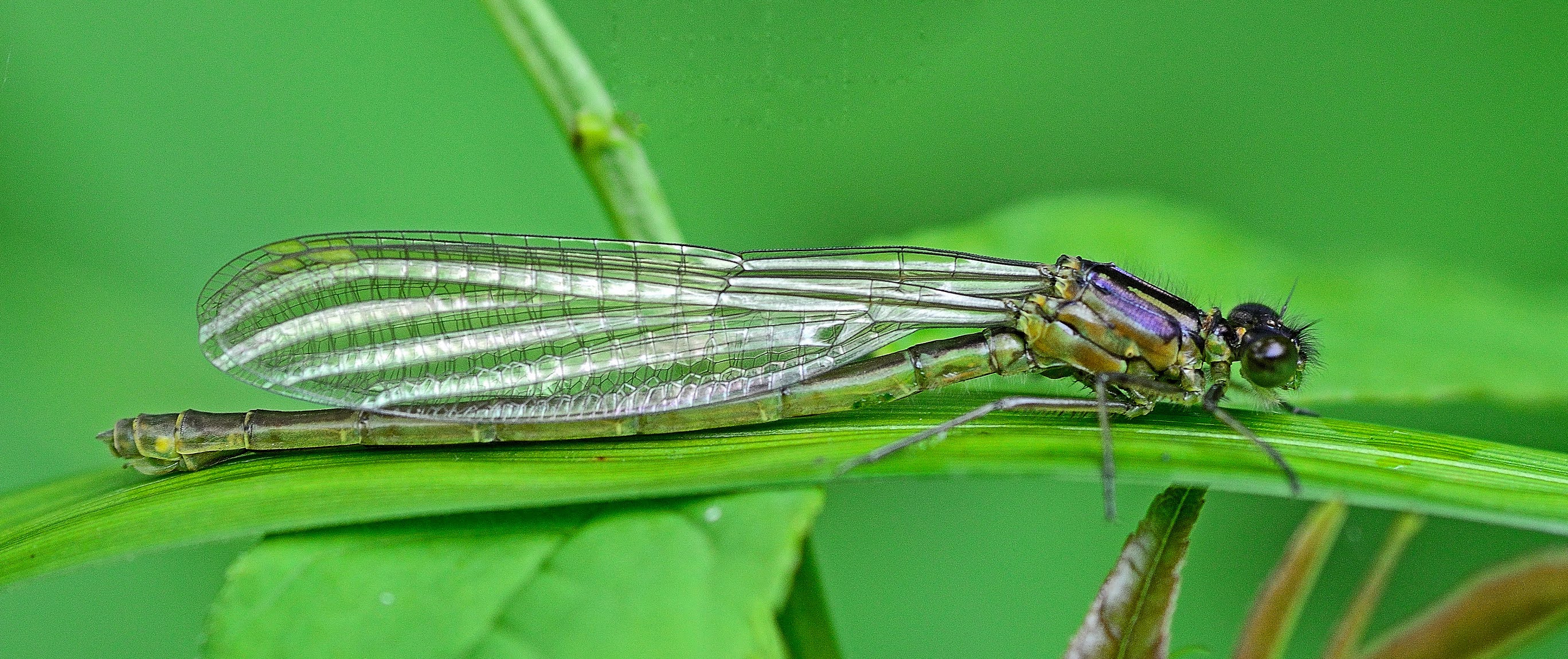
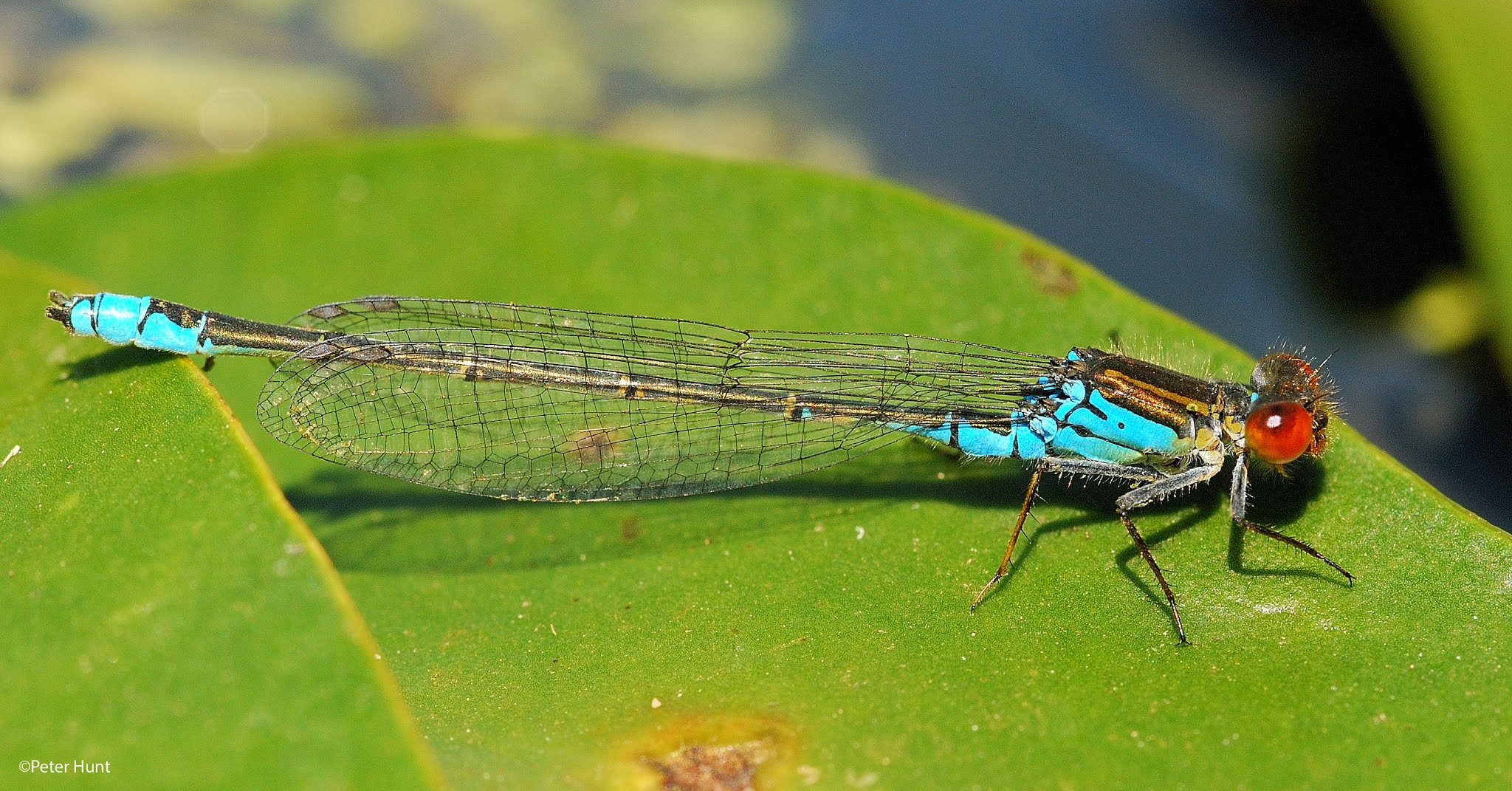
Another blue damselfly is the Red-eyed Damselfly which is quite commonly seen here at large ponds and standing water bodies, particularly with floating vegetation  such as water-lilies. Females and immatures tend to be yellowish-green in colour and new emergents have purple tones in both male and female. They can sometimes be in the company of the Small Red-eyed Damselfly although the former is on the wing in May whereas the Small Red-eyed emerges in late June or July.


Similar in appearance to the Red-eyed is the Small Red-eyed Damselfly. This species was  first recorded only twenty years ago on the Isle of Wight and has now spread around the Island. It too likes ponds with surface vegetation but is quite happy in smaller ponds unlike the Red-eyed. Females can be yellow, green, or blue.


Sunday, 7 February 2021

Our Island Resident Species-Damselflies(1).

 Although several counties of the UK can boast more species, the Isle of Wight has,  to the best of my knowledge, twenty three species of dragonfly and damselfly.  All our damselflies are generally common around the UK, however that changed somewhat with the discovery of the Southern Emerald Damselfly, Lestes barbarus, in 2017 in a forested site in the West Wight. It was later confirmed that this new species has been at this location since at least 2015.

Perhaps the three most prolific species of damselfly are the Azure,Large Red,and the Blue-tailed.Closely following them in abundance could be the Common Blue Damselfly.The Azure is found in particular, in small ponds and ditches and emerges in the spring.The male is blue and the female has two colour forms,green with black and  a blue form.


Emerging slightly eariler than the Azure is the Large Red Damselfly.Another very common species and found in various habitats.There are three colour forms in the female including the mainly black  melanotum. 


Colour forms are again seen in the Blue-tailed Damselfly with five in the female. Perhaps the most attractive is violacea, a  colour seen in some immature females displaying lilac sides to the thorax. Another is  rufescens with orange-pink sides.


. 


Monday, 26 October 2020

2020,a Year to Forget & Remember.

 This year coronavirus  has dominated all our lives.The result of the pandemic regarding odonata for me has been to restrict my boundaries solely to the Isle of Wight.Any opportunity to seek the more exotic species abroad were dashed and even trips to mainland Britain were abandoned.

The season began on the 12th April with Large Red Damselflies emerging in the garden and an immature male Broad-bodied Chaser flew in on the 23rd of the month.In the middle of May there were good numbers of Beautiful Demoiselle at Shalfleet Stream.May is also the time that I turn my attention to Bouldnor Forest at Yarmouth for hopefully the first signs of the Southern Emerald Damselflies,Lestes barbrus. It was on the 25th when an immature female was seen and that was followed by sightings of several individuals well into June.However I must say that numbers were very small and after the last record on the 20th of the month no more were seen until a lone mature female on the 20th August.

The highlight of the season occurred at the end of July when,also at Bouldnor,a male Southern Migrant Hawker,Aeshna affinis, was spotted patrolling one of the almost dried up ponds.The following day the 31st July,it was again present and stayed in this location until the 11th August.Five days earlier on the 6th I noted two males vying over this now dry pond.

Immature male Broad-bodied Chaser

Female Beautiful Demoiselle


Immature female Lestes barbarus


Thursday, 20 August 2020

Southern Emerald Damselflies Show At Last.

Two months after my last sighting of Lestes barbarus at Yarmouth a single female was seen today. Interestingly enough although on site, she was not particularly close to the two breeding scrapes and disappointingly she gave me the slip soon after discovery.
However it is pleasing to know that they are there and perhaps still in dispersal mode.


Friday, 7 August 2020

Small Red-eyes at Stag Lane Pond.

Stag Lane pond is situated near to Newport on the Isle of Wight and close to the Dodnor Creek Nature Reserve bordering the River Medina.The pond is a renowned fishing lake and also a place for many species of odonata.At this time of year Small Red-eyed Damselflies abound and today under cloudy skies but high temperatures of over 30 degrees celcius several males were resting on pondside foliage.


Thursday, 6 August 2020

Southern Migrant Hawker Defends Pond Against Rival.

At Bouldnor Forest ponds today the male Southern Migrant Hawker was patrolling his rapidly diminishing pond in spite of the attentions of another male.It would seem that this site has a very suitable habitat for this species as other ponds on the site have dried up too,save two that have a low water level and are guarded by  male Emperor Dragonflies. 
At the Southern Emerald  scrapes only a female Lestes sponsa was recorded and it is hoped that soon Lestes barbarus will return to breed.