Showing posts with label Scarce Chaser. Show all posts

Thursday, 11 February 2021

Our Island Resident Species-Dragonflies(1).

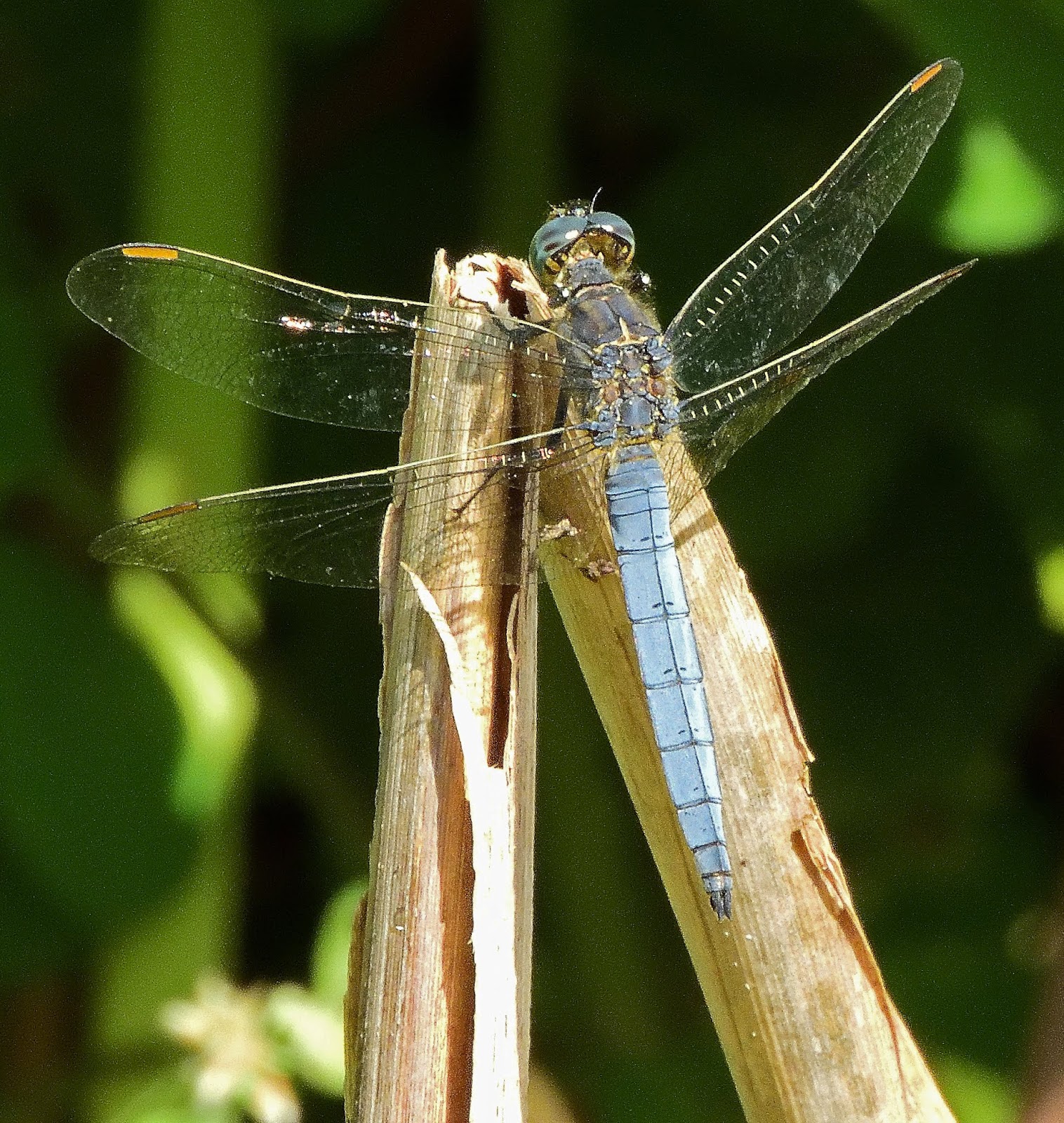
 As far as I am aware the Scarce Chaser Libellula fulva  has been breeding on the Isle of Wight for less than ten years. The preferred habitat is water meadows with slow flowing waterways and sometimes mature ponds as well as fishing lakes with dense marginal vegetation. Any small open stretches are favoured by the males in order to perch on the emergent plants.


A common chaser here is the Broad-bodied Chaser. The first adults are seen in April when as immature, the males have the same colouring as females. As they mature males take on a blue abdomen whereas the females remain yellowish-brown. However some very mature females may develop limited pruinosity


The third chaser is of course the Four-spotted Chaser. Although never common on the Island it has made a resurgence recently. Once mainly found  close to Brading Marsh it seems to have spread far and wide and can be encountered in a variety of habitats.  A male even turned up at my garden pond some time ago.


Wednesday, 29 May 2019

White-legs Under Pressure.

On a holiday to the Greek Island of Meganisi last week there was time to spent an hour or so in Nydri on Lefkada.A visit to a favoured site for dragonflies was a disappointment as the area has succumbed to development with many lots fenced off and up for sale.The result was that only one male Scarce Chaser was recorded along with several White-legged Damselflies.


Monday, 4 June 2018

Anceps.

Although the Scarce Chaser tends to dominate the streams and ditches around the town of Nydri on the Ionian Island of Lefkada,there is another dragonfly that shares this habitat.In the southern Balkans the Keeled Skimmer subspecies anceps is dominate, where the adult male may be all-pruinose.Unlike the Keeled Skimmers of northern Europe anceps frequent streams and ditches whereas its northern cousin prefers boggy acidic runnels.
A great surprise to me was also the sighting of a male Southern Skimmer Orthetrum brunneum, a species very similar to the Keeled Skimmer but differing in several features. 


A male Southern Skimmer

Immature male


Immature female

Sunday, 3 June 2018

Showing Off Those Legs.

As well as Scarce Chasers scattered on suitable habitat around the ditches and streams on the outskirts of Nydri,Lefkada there are also other odonata species to enjoy.Not least are White-legged Damselflies Platycnemis pennipes. These attractive damselflies are numerous at this time and can be seen gliding among the reeds in search of a sunny spot.The male is a handsome blue with dark markings and has very expanded white legs which it uses for display. The females have a overall cream colour turning green when mature.


Thursday, 31 May 2018

Scarce Chasers Abound.

Known as the Scarce Chaser in the UK and the Blue Chaser on the continent this species is very specific in its habitat requirements.Consequently populations are very localised and as would suggest in its name this Chaser has a restricted UK range. However in favoured spots numbers can be abundant and around the town  of Nydri,Lefkada there are still many such spots.These streams and ditches which in the winter take rainwater from the hills and mountains to the sea, are at this time a perfect breeding habitat for this Chaser.


Tuesday, 14 June 2016

Banded Demoiselles Out in Force.

On a recent trip to seek out the Scarce Chaser as described in my entry of the 8th June,I was happy to see that the Banded Demoiselle is enjoying a good season with large numbers evident all around the stream frequented by the Scarce Chaser 


Wednesday, 8 June 2016

Scarce Chaser Returns.

Two years ago  we were fortunate enough to see several Scarce Chasers at an ideal habitat for them on the Isle of Wight.Despite another visit last year at this time none were to be seen at the site.This perhaps was due to the fact that it normally takes larvae two seasons to develop and emerge.
The signs were good this time, as some Chasers have been reported from another known Island site as well as one immature male seen a week or two ago at our location.The weather today was hot and muggy with hardly any breeze so the conditions were favourable.After some time investigating the slow moving stream  dotted with small open areas clear of reeds a mature male was spotted.He proved to be very accommodating by landing a frequent intervals on nearby reed stems. 


Tuesday, 2 June 2015

Back to Lefkada.

This is the ideal time of the year to visit a favourite Greek Island of mine.In and around the coastal town of Nidri on Lefkada there are a host of dragonflies and damselflies to see.The small streams that gently flow into the sea here are clogged with reeds in places and are a perfect habitat for the Scarce Chaser.The adult males can be found in good numbers, along with other species that like these conditions such as White-legged Damselflies and Keeled Skimmers.But perhaps the most exotic dragonfly to grace these streams is the Violet Dropwing and in particular the colourful male.


Saturday, 25 October 2014

This Year's Top Highlight.

The 2014 season has seen a succession of  highlights with visits to the only remaining colony of Keeled Skimmers,Orthetrum coerulescens, on the Isle of Wight,to my first ever look at the Small Skimmer,Orthetrum taenioaltum,on the island of Rhodes.
Ferocious winter gales and heavy rain caused massive erosion of the coastal cliffs where the Keeled Skimmer is found here, in acidic pools on the cliff landslips.Hopefully as new pools are created their numbers will increase.
Another fantastic discovery was the sight of numerous male Red-veined Darters on territory at a local reservoir. These colourful darters are reported from time to time in singles but double figure numbers are quite unusual and exciting particularly on the Isle of Wight.
However the real highlight of this past season for me are the encounters with the Scarce Chaser. The odd individual has been noted since 2008 on the Island but this year several were seen at suitable breeding locations.Both these sites are in the south east of the Island,one in water meadows on a small, muddy slow  flowing river. and also at  mature fishing lakes surrounded by dense emergent marginal vegetation.
Males on territory and females were present at both sites.
The Scarce Chaser,Libellula fulva,is a 'Red Data' species and along with several other species they are considered as 'near threatened'.Therefore they and their habitats are protected by law in the UK.


Monday, 23 June 2014

More Scarce Chasers

A morning visit to private fishing ponds on the Island and three Scarce Chasers.The two males were perching in the sun for all to see but the third a female,was in reeds adjacent to the path and would have been missed if we had not seen it land.She stayed stock still for some time and gave us close views of her beautiful colouring.
Also at the ponds today,a large population of Red-eyed Damselflies.mainly out on the water on the lily pads,a male Downy Emerald,also a  male Black-tailed Skimmer,together with an Emperor Dragonfly and an early Southern Hawker, in flight.