Saturday, 7 July 2018

More Emerald Damselflies To See.


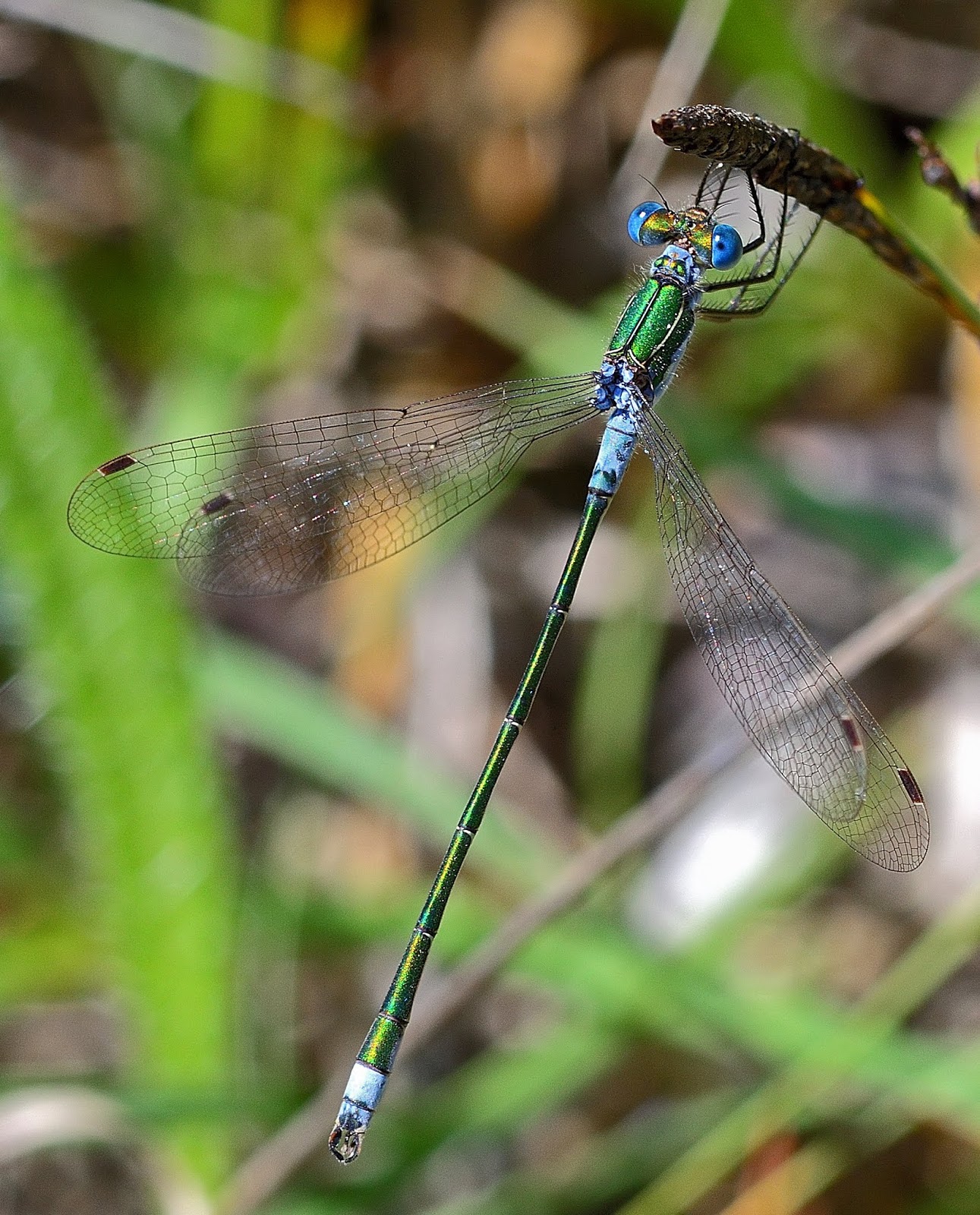
Yesterdays visit to Bouldnor Forest ponds discovered the effects of our rather prolonged dry spell.Temperatures have reached 30C almost every day for the last couple of weeks and the levels in the scrape ponds are receding fast.Not surprisingly at the two Southern Emerald breeding scrapes water has seemingly disappeared and now Emerald Damselfly Lestes sponsa numbers are starting to increase with up to six adult males,three copulating pairs,and several females seen. 


Friday, 6 July 2018

Business As Usual for the Small Red-eyes.

There were at least five adult male Small Red-eyed Damselflies on the lily pads at a Shalfleet garden pond this morning.Hopefully it will be another good season for this species with activity increasing as the season progresses.


Monday, 2 July 2018

Small Red-eyes Appearing.

The first report of Small Red-eyed Damselflies on the Isle of Wight was on the 26th June.This was six days later than 2017  when two individuals were recorded in the village of Shalflleet.Therefore I was hopeful if not expectant that I would see adult males at a garden pond in the village.
My optimism it seemed was misplaced as despite some searching there was no sign of any Small Red-eyes.However a persistant scan of the numerous lilypads on the pond discovered a teneral damselfly preparing to take its first flight .More searching revealed a second emergent struggling to escape from its laval case as seen in the sequence of photos below.


Small Red-eye almost ready for its first flight.


Starting to emerge from its larval case.

Out but still with folded wings.

Wings almost developed.


Abdomen nearly straight.
Not too long to take off.

Saturday, 30 June 2018

The Colour of an Emerald Too..

Another Emerald Damselfly common here on the Isle of Wight is Lestes sponsa.Its required habitat is similar to that of Lestes barbarus but L. sponsa is well established in the UK and widespread.The males develop a powder blue pruinescence over some of the thorax and parts of the abdomen.The eyes are blue.The females on the other hand lack any blue and are slightly heavier in appearance.Their eyes are brown.
Several individuals were seen today at Yarmouth and although numbers will increase as the summer proceeds it is not likely that the numbers of Lestes sponsa will be large.   


The Colour of an Emerald.

The classic colour of an emerald gemstone is green but they can range from yellow-green to blue-green.The same can be said of our Emerald Damselflies.More so since the recent addition of the Southern Emerald Damselfly Lestes barbarus to the Isle of Wight.Now that mature adults are seen around their breeding pools at Yarmouth it is noticeable that the eyes and antehumeral stripes on the thorax have turned an 'apple' green, while still retaining their main overall colour of metallic green.In addition the abdomen  shows a hint of bronze along the upper side.
Today with a temperature of over 30C it was a hot afternoon at Bouldnor ponds.I was joined in a count of Lestes barbarus by two other enthusiasts who had made the trip over from the mainland.Together we managed to find four adult Southern Emeralds in close proximity to the breeding pools.


Thursday, 28 June 2018

Beautiful Demoiselles Steal The Show.

A  trip on the car ferry and a short drive  to the Hampshire town of Whiteley yesterday was ostensibly in search of butterflies.However dragonflies took main attention as the area visited is criss-crossed with wooded streams and brooks. Here there are Beautiful Demoiselles at any sunny spot and also the occasional Golden-ringed Dragonfly patrolling the waterway.
The short sequence of photos below show a female demoiselle ovipositing into a reed stem at one such wooded stream,choosing a small sunny glade.After laying into the stem she went to a branch very close by either to continue egg laying or perhaps to clean herself.


Tuesday, 26 June 2018

On The Rise.

We are enjoying a prolonged spell of hot and dry weather now and dragonfly activity has increased.This morning a trip to a garden pond in the nearby village of Shalfleet resulted in no sign of the first Small Red-eyed Damselflies.
However there were other odonata to be seen including this male darter in what for me is a rare sight in the UK.The obelisk postion taken by dragonflies can be a way of keeping cool in hot conditions.The abdomen is raised so as to modify the surface area that is directly exposed to the heat of the sun and both males and females can regulate their body temperartures in this way.


Sunday, 24 June 2018

Something Common.

During my recent trips to Bouldnor Forest to see our Southern Emerald Damselfly colony there was it seems, a constant stream of Common Darters emerging from the breeding pools.However it was not until today that the first Common Darter appeared at my garden pond.As the season progresses many more will be dotted around my garden until late into the year.


Thursday, 21 June 2018

Drought-like Conditions Suit Our Southern Emeralds.

Todays visit to the Southern Emerald Damselfly site near Yarmouth produced a total of three adult damselflies,two male and one female, on the immediate margins of the smaller of the two breeding pools.Not surprisingly the water level  at both pools is very low with just the centre having any noticeable water.However this seems to be normal as in past seasons both pools began to dry out at this time.


Thursday, 14 June 2018

Summer Dragonflies on the Wing.

In Bouldnor Forest today a first Southern Hawker hunting along the forest ride.At the ponds one mature Ruddy Darter and another maturing Ruddy Darter.While observing the Southern Emerald Damselflies a first Emerald Damselfly Lestes sponsa was spotted.